
Full Bore vs Reduced Bore Ball Valve
One letter on a specification, a measurable difference in the pipeline. Full bore passes what the pipe passes; reduced bore does not.
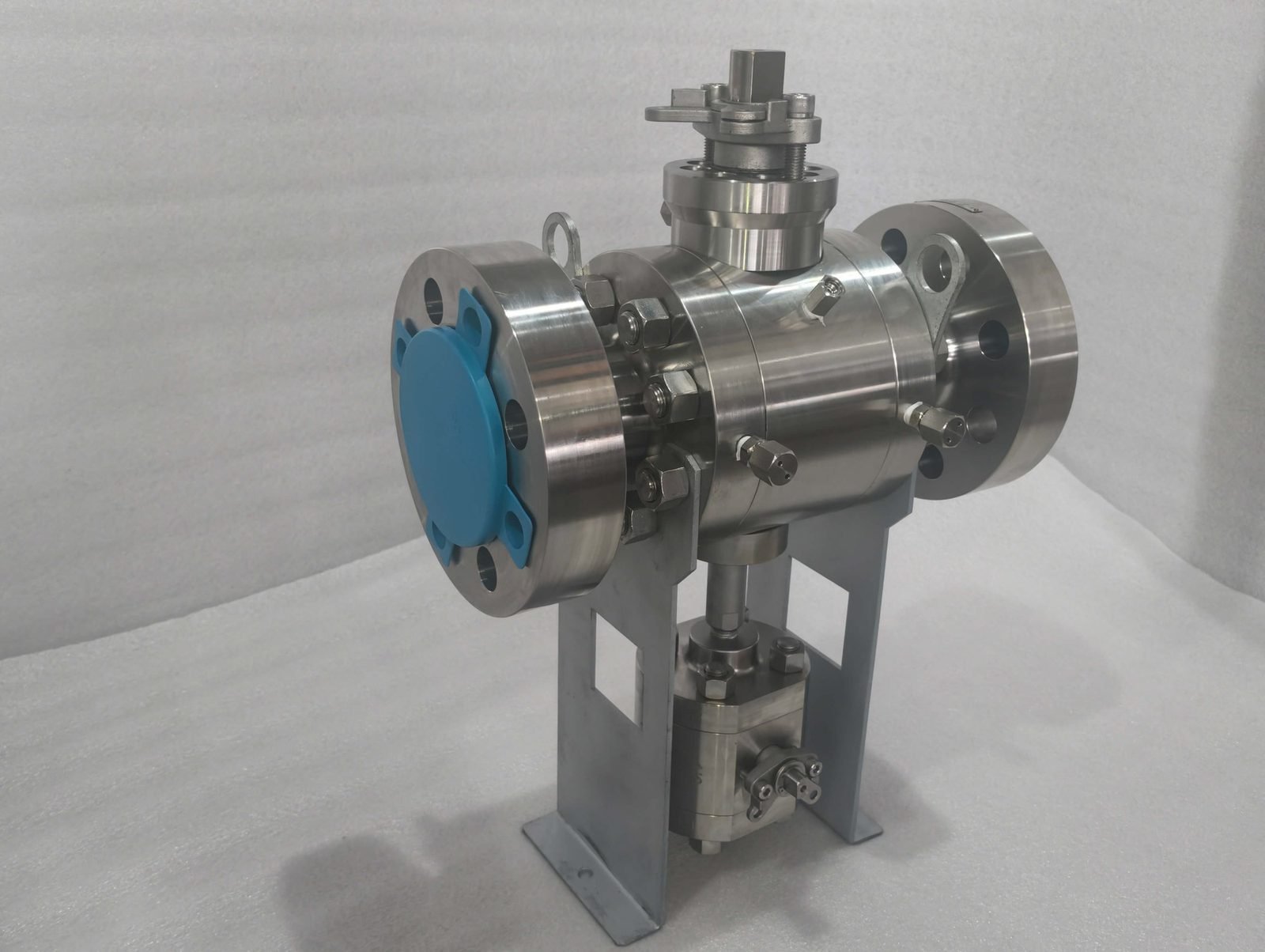
Full Bore vs Reduced Bore Ball Valve
A full bore ball valve has an internal diameter equal to the pipe it sits in. A reduced bore valve has a smaller port, typically about one nominal size down, with the same outside dimensions and the same flange pattern.
That reduction is invisible from outside and decisive in service, because anything that has to travel along the line has to pass through it.
Full bore against Reduced bore
| Aspect | Full bore | Reduced bore |
|---|---|---|
| Internal bore | Matches the pipeline bore | One or two sizes smaller than the line |
| Pigging and sphere passage | The valve passes what the line passes | Will stop a conventional pig |
| Pressure drop | Minimal, essentially the pipe itself | Measurable, and it rises with the reduction |
| Weight and outside dimensions | Larger and heavier for the same bore | More compact for the same line size |
| Torque | Higher, the ball is larger | Lower |
| Cost | Higher: material, machining, actuator | Lower; often the cheapest way to isolate a line |
| Typical use | Pipelines, pigging, high-flow duties | General plant isolation where flow is not restricted |
Pigging is the hard requirement
Any line that will be pigged, swabbed or swept with a sphere needs full bore valves on it, because a pig that reaches a reduced port stops there. This is the single requirement that cannot be traded against cost.
The same applies to lines carrying anything that must not be obstructed: instrument pigs, cleaning devices and, on some duties, the product itself.
Pressure drop and running cost
A reduced bore adds a contraction, a straight section and an expansion to the flow path, and each of those costs pressure. On a short line at low velocity the cost is minor; on a long line at high velocity it is a permanent charge against the pumps.
The calculation is straightforward and worth doing on any line above a few hundred metres, because the saving on the valve is often smaller than the extra pumping cost over the valve's life.
What you get for the money
A reduced bore valve is smaller, lighter, lower in torque and cheaper, and on a plant isolation line where nothing has to pass through it, that is entirely the right trade. Many refineries are full of reduced bore ball valves used exactly that way.
The mistake is to fit a reduced bore valve on a line that is later pigged, or to fit one and then discover that the flow restriction, not the valve, becomes the constraint on throughput.
Which one to choose
- Choose full bore. Pipelines, pigging duties, high-flow lines, and any service where the valve must not become the flow restriction.
- Choose reduced bore. General plant isolation on lines that are not pigged, where the smaller size, lower torque and lower cost are the point.
From the works and the projects
Questions this page answers
No, not a conventional pig. Full bore valves are required wherever the line is pigged or swept, which is why pipeline specifications call for them.
It depends on the bore reduction and the flow velocity, but it is a permanent loss rather than a one-off. On long or high-velocity lines it is worth calculating before purchase rather than after.
No. The class rating is unchanged; what changes is the flow path and the operating torque, which is normally lower than the equivalent full bore valve.