
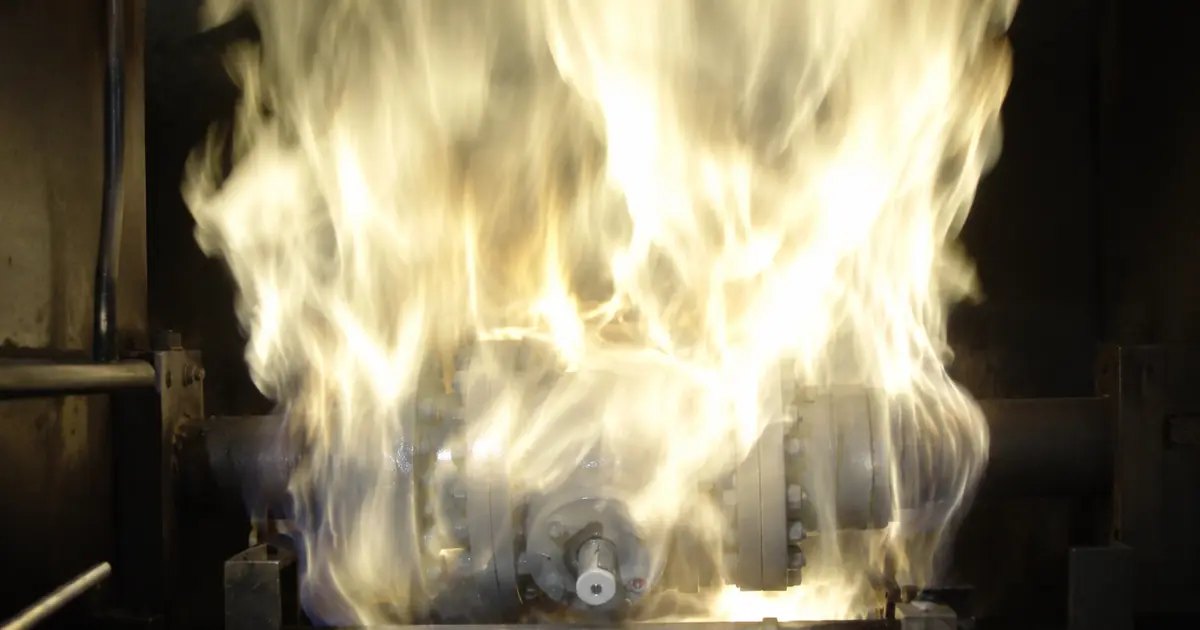
Flanged ball valve during a 30-minute API 607 fire test burn.
API 607 is the fire type test for quarter-turn valves and valves with nonmetallic seating. API 6FA is the fire test for valves built to API 6A and API 6D, so pipeline and wellhead projects name it to keep fire qualification inside the same specification family as the valve.
Both standards require a destructive type test on a single sample valve. Passing the test qualifies a defined range of sizes and pressure classes, allowing production valves within that range to carry the 607 or 6FA marking without individual fire testing.
1. API 607: scope, edition and burn conditions
The current edition is API 607 eighth edition, October 2022, Fire Test for Quarter-turn Valves and Valves Equipped with Nonmetallic Seats. Its scope covers quarter-turn valves with nonmetallic or metallic seats, plus other operated valves with nonmetallic seating. The TSV ECM certificates on file were issued against the seventh edition, June 2016, and the test conditions below follow that edition.
A closed valve, filled with water and pressurised, burns for 30 minutes (+5 / −0 min). The flame environment average reaches 750 °C within 2 minutes and holds between 750 °C and 1000 °C, with no single reading below 700 °C. Calorimeter cubes reach an average of 650 °C within 15 minutes and hold it to the end of the burn, with no cube below 560 °C.
Test pressure during the burn is 0.2 MPa for nonmetallic-seated valves rated Class 150 and Class 300. All other valves burn at 75 % of the maximum permissible seat working pressure at 20 °C.
Within 5 minutes of flame-out the valve is force-cooled until its outer surface is below 100 °C, and cooling may take no more than 10 minutes. Valves rated Class 600 and lower then take a low-pressure through-seat test over 5 minutes. The valve is operated to fully open against the high test pressure, and external leakage is measured over 5 minutes in that position.
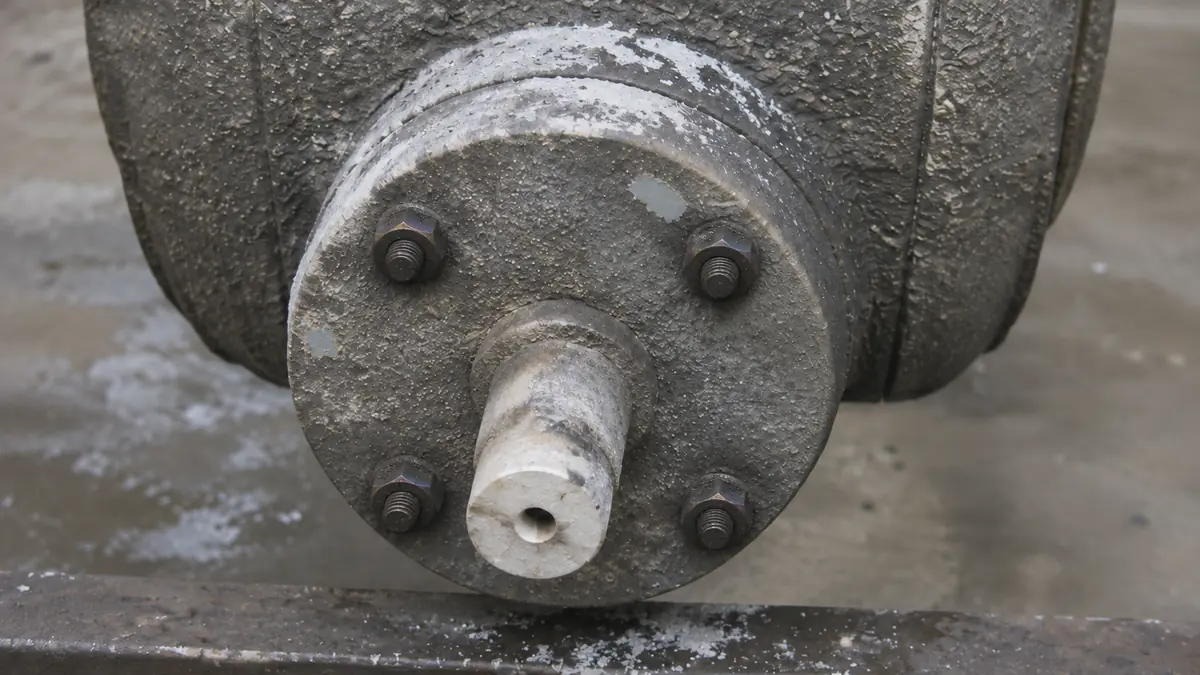
Ball valve stem and top mounting flange after fire exposure and forced cooldown.
Size qualification runs up to twice the tested size, and an NPS 8 test valve qualifies all larger sizes. Class qualification follows API 607 Table 4, where a Class 1500 test qualifies Class 1500 and Class 2500.
Actuators are excluded from the standard, except for manual gearboxes that form part of the normal valve assembly. Electric, pneumatic, and hydraulic actuators require separate fire protection, which is covered on the API 607 / ISO 10497 standard page.
2. API 6FA: scope, edition and burn conditions
The current edition is API 6FA sixth edition, April 2026, Standard for Fire Test of Valves. It sets requirements for testing and evaluating the pressure-containing performance of API 6A and API 6D valves exposed to fire. The sixth edition adds hybrid qualification where stated conditions are met. The TSV ECM certificates on file were issued against the fifth edition, 2020.
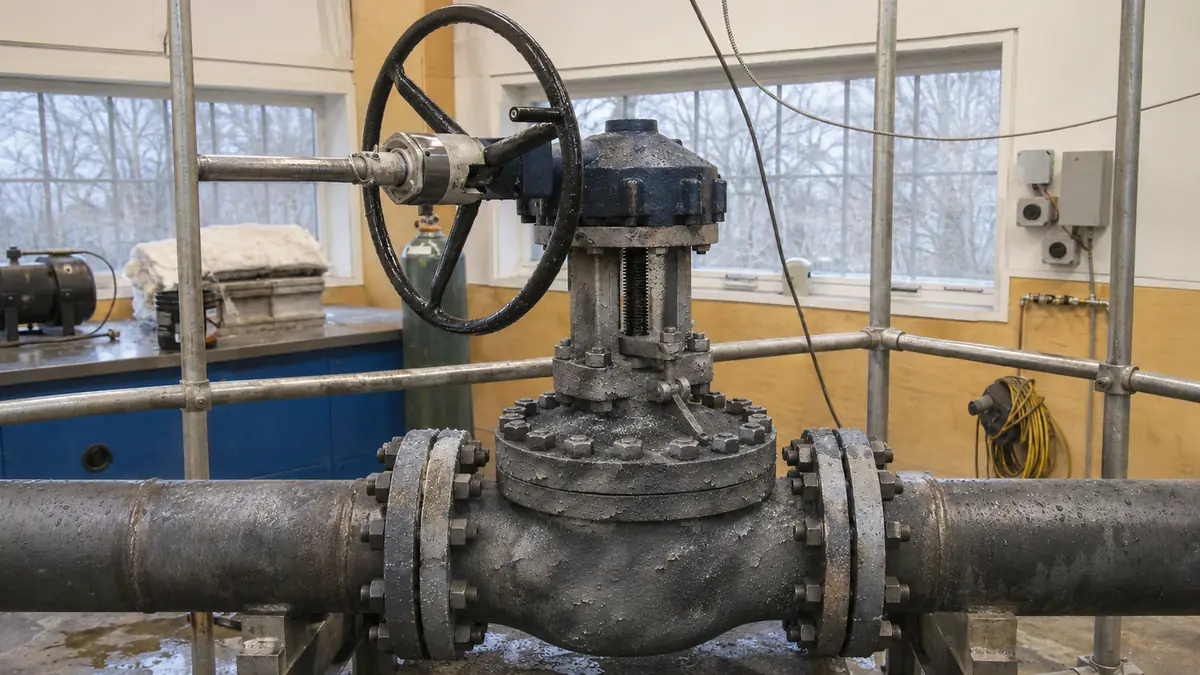
Gate valve with bevel gear operator mounted in an API 6FA fire test rig.
Because API 6FA is tied to the valve design specification, it applies to gate, ball, plug, and check valves built to API 6A or API 6D. A gate valve built only to API 600 must be specified and manufactured to API 6D if a pipeline project requires API 6FA certification.
A water-filled valve burns for 30 minutes. The flame average reaches 1400 °F (760 °C) within 2 minutes and holds between 1400 °F and 1800 °F (760–982 °C), with no reading below 1300 °F (704 °C). Calorimeter cubes reach an average of 1200 °F (649 °C) within 15 minutes and hold it, with no calorimeter below 1050 °F (566 °C). After the burn the valve cools to 212 °F (100 °C) or less, by natural or forced cooling at the manufacturer's choice.
High test pressure during the burn comes from the class table in the standard. The low-pressure test after cooldown applies to API 6D valves rated Class 600 and lower, measured over 5 minutes. The valve then opens against the high test pressure differential, and external leakage in the open position is measured over 5 minutes.
Size qualification runs up to twice the tested size, and the TSV certificates show an NPS 8 test valve qualifying NPS 8 and larger under 6FA Table 4. Pressure class qualifies up to twice the tested rating under Table 6, so a Class 150 test qualifies Class 150 and Class 300.
3. API 607 and API 6FA, side by side
The table below compares the test parameters across both standards. API 6FA temperatures are listed in °F as written in the standard, with °C equivalents in parentheses.
| Item | API 607 | API 6FA |
|---|---|---|
| Current edition | Eighth edition, October 2022 | Sixth edition, April 2026 |
| Edition on TSV certificates | Seventh edition, June 2016 | Fifth edition, 2020 |
| Scope | Quarter-turn valves with nonmetallic or metallic seats, and other operated valves with nonmetallic seating | Valves to API 6A and API 6D |
| Typical valve types | Ball, butterfly and plug valves | API 6D gate, ball, plug and check valves; API 6A wellhead valves |
| Burn period | 30 min (+5 / −0) | 30 min |
| Flame average | 750–1000 °C, no reading below 700 °C | 1400–1800 °F (760–982 °C), no reading below 1300 °F (704 °C) |
| Calorimeter average | 650 °C within 15 min, no cube below 560 °C | 1200 °F (649 °C) within 15 min, no cube below 1050 °F (566 °C) |
| Pressure during burn | 0.2 MPa for nonmetallic-seated Class 150 / 300; 75 % of max seat working pressure at 20 °C for all others | High test pressure by class table |
| Cooling | Forced, below 100 °C within 10 min | To 212 °F (100 °C) or less, natural or forced |
| After cooling | Low-pressure seat test (Class 600 and lower), open against high pressure, external leakage over 5 min | Low-pressure seat test (API 6D, Class 600 and lower), open against high pressure differential, external leakage over 5 min |
| Leakage limits | Set by size in Table 1 for each test phase | Through-seat during burn 400 mL/in/min; external during burn and cooldown 100 mL/in/min; low-pressure through-seat 40 mL/in/min; low-pressure external 20 mL/in/min; external in open position 200 mL/in/min |
| Size qualification | Up to 2 × tested size; NPS 8 qualifies all larger | Up to 2 × tested size; NPS 8 qualified 8 and larger on TSV certificates |
| Class qualification | Table 4: Class 1500 qualifies 1500 and 2500 | Table 6: Class 150 qualifies 150 and 300 |
| Valve marking | 607 | 6FA |
| International equivalent | ISO 10497 | None |
4. Selecting the test from the project document
Start with the project datasheet or piping specification. If the document specifies API 607 or API 6FA, follow that requirement. When a specification lists both standards, the buyer and manufacturer should confirm in writing which test governs each valve tag before order placement. If neither test is listed on a fire-safe line, clarify the requirement at the inquiry stage, since fire qualification cannot be added to a finished valve without running a new witnessed burn test on that design.
Check the standard edition next. When a project specification calls for API 607 eighth edition or API 6FA sixth edition, confirm in the technical clarification sheet whether certificates issued under the seventh or fifth edition are acceptable.
Match the valve type to the standard's scope. Quarter-turn ball, butterfly, and plug valves generally qualify under API 607. Gate valves qualify under API 6FA when built to API 6A or API 6D. An API 6D ball valve can be tested to either standard depending on the project specification; see the API 6D vs API 608 comparison if the valve design standard itself is not yet settled.
Finally, verify the ordered size and pressure class against the qualified range on the certificate. A valve even one pressure class above the tested qualification range is not covered by that certificate, even if it shares the same body and seat design.
5. TSV fire certificates on file
All current TSV fire certificates were issued by Ente Certificazione Macchine (ECM), Italy, to Zhejiang Tiansheng Valve Co., Ltd. Each certificate number in the table below links directly to the PDF, and the full qualification package is available on the TSV certificates page.
| Certificate No. | Standard and edition | Test valve | Qualified range | Expiry |
|---|---|---|---|---|
| 1N230925.ZTVCD94 | API 607, 7th ed. | 2" Class 1500 ball valve, A105N body, PEEK seats | NPS 2 and below, 2½, 3, 4; Class 1500 / 2500 | 24 Sep 2028 |
| 1N230728.ZTVQ053 | API 607, 7th ed. | 4" Class 1500 ball valve | NPS 4, 5, 6, 8; Class 1500 / 2500 | 27 Jul 2028 |
| 1N230925.ZTVCD95 | API 607, 7th ed. | 8" Class 1500 ball valve | NPS 8 and larger; Class 1500 / 2500 | 24 Sep 2028 |
| 1N250515.ZTVDS40 | API 6FA, 5th ed. | 2" Class 150 gate valve, WCB body, F316 + Stellite seats | NPS 2, 2½, 3, 4; Class 150 / 300 | 14 May 2030 |
| 1N250515.ZTVDS41 | API 6FA, 5th ed. | 4" Class 150 gate valve | NPS 4, 6, 8; Class 150 / 300 | 14 May 2030 |
| 1N250515.ZTVDS42 | API 6FA, 5th ed. | 8" Class 150 gate valve | NPS 8 and larger; Class 150 / 300 | 14 May 2030 |
| 1N260302.ZTVU026 | API 6FA, 5th ed., with API 6D | 8" Class 150 slab gate valve, WCB body, F316 + RPTFE seats | Slab gate, NPS 8 and larger; Class 150 / 300 | 1 Mar 2031 |
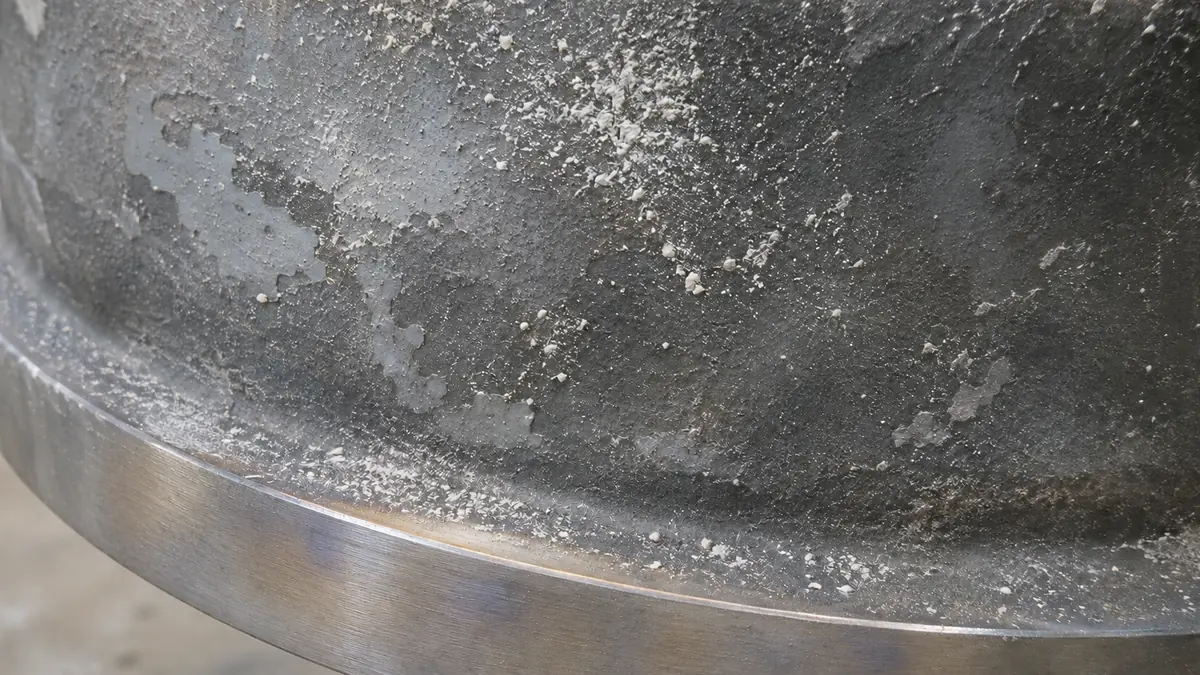
Valve body flange after fire testing, showing blistered coating and heat tint.
The three API 607 certificates together cover ball valves of every size at Class 1500 and Class 2500. The four API 6FA certificates cover gate valves from NPS 2 upward at Class 150 and Class 300, and the slab gate certificate covers API 6D pipeline slab gates from NPS 8 upward in the same classes.
An earlier DNV-witnessed test (record SHA/872728/1301-677) qualified 8" Class 600 trunnion-mounted ball valves to API 607 sixth edition, covering NPS 8 and larger in Classes 600, 800, and 900. Because the sixth edition was superseded in 2016, this DNV fire test record is retained as historical test documentation rather than active certification.
Ball valves at Class 150 to Class 900 therefore have no TSV fire certificate issued against the seventh or eighth edition of API 607. An order for a trunnion-mounted ball valve in that class range with a fire requirement needs a new witnessed test, and the TSV technical team quotes the test cost and schedule with the valve.
Every TSV valve is serialized and shipped with a Quality Dossier containing EN 10204 3.1 or 3.2 inspection documents. While the fire test certificate qualifies the valve design, every production valve undergoes routine hydrostatic shell and seat testing to API 598 or API 6D before shipment.
6. Frequently asked questions
Does a ball valve with an API 607 certificate automatically qualify under API 6FA?
Is a certificate issued against an earlier edition still valid?
What happens when a fire certificate expires?
Which TSV ball valves have no current fire certificate?
Is a fire test carried out on every valve ordered?
What if the project names both tests, or neither?
Need a Fire Certificate Scope Check?
Send your valve list with size, class and the fire test your project names. The TSV technical team confirms which certificate covers each tag, or quotes a new witnessed test.