
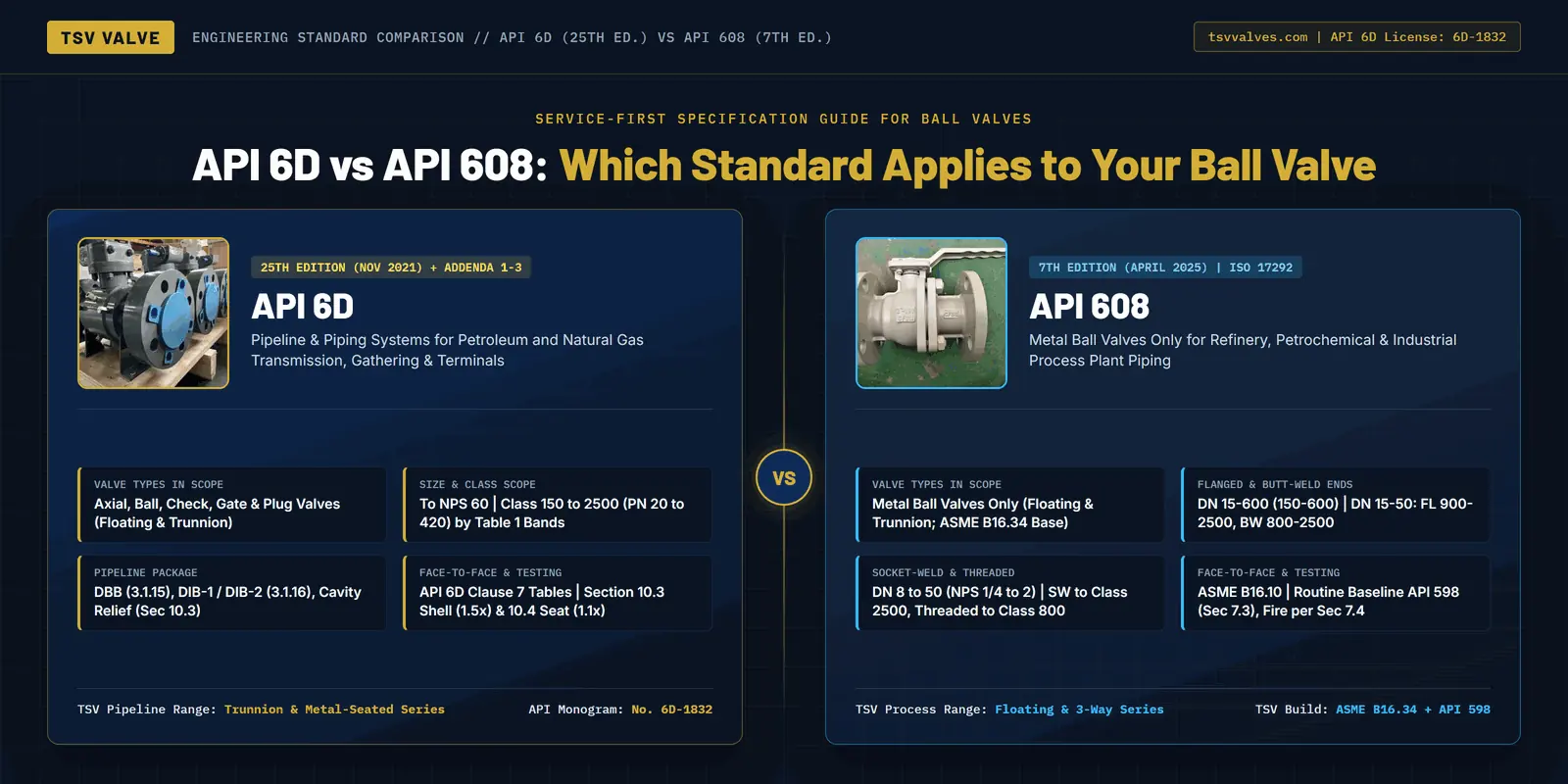
API 6D governs pipeline and piping valves for petroleum and natural gas service. It covers axial, ball, check, gate, and plug valves in transmission and gathering systems.
API 608 governs metal ball valves only, for petroleum, petrochemical, and industrial applications. It covers flanged, threaded, and welding-end valves in process facilities.
You usually meet this question on a data sheet. The sheet names a standard, or it names none, and the valve still has to isolate its line.
This guide works from the service first. It starts with where the valve sits and what it must do, then checks size, class, and end type against the standard that fits that service.
TSV's ball-valve family covers both pipeline and process duties, so the examples below come from TSV pages. Each example names a series, with its stated design standard.
1. What API 6D covers
API 6D is the pipeline standard in this pair. It covers pipeline and piping valves for petroleum and natural gas service, including axial, ball, check, gate, and plug valves.
The current title is Specification for Valves, 25th edition, published 2021-11-01, with Errata 1 to 3 and Addenda 1 to 3. PHMSA has incorporated the 25th edition into 49 CFR 192 and 195, effective 2026-01-01.
The scope runs to NPS 60, in Classes 150 to 2500, which is PN 20 to 420.
That scope is wider than one valve type. A mainline ball valve, a gate valve, and a check valve at a pump station can all sit under one pipeline document set.
Size under 6D is not a single range. It is set by class band in Table 1, so a size available at one class may not be available at another.
Ball valves under 6D include floating and trunnion designs. Trunnion mounting carries the load on bearings, which suits large sizes and high differential pressure, while a floating ball relies on line pressure to push it onto the downstream seat.
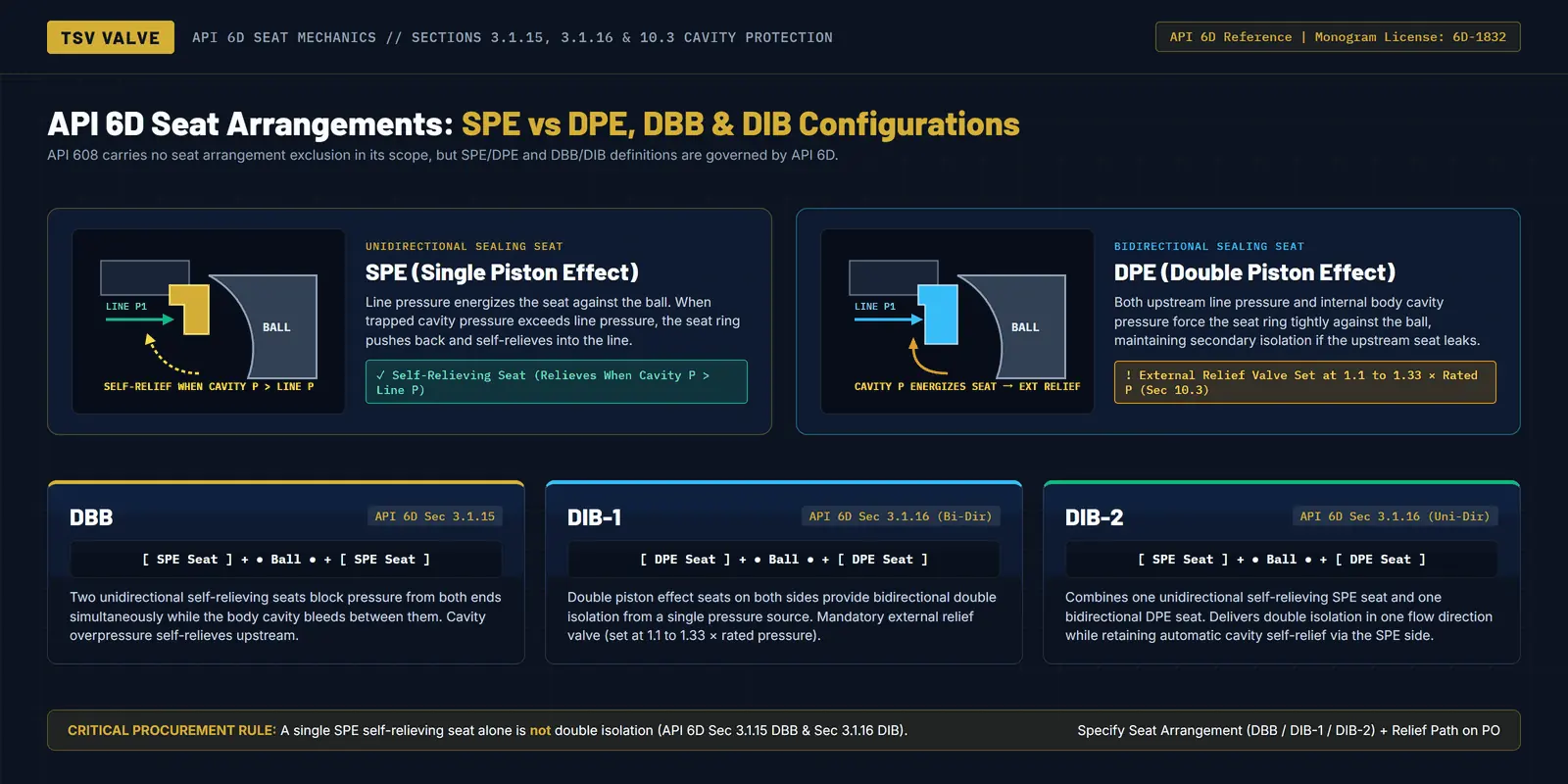
Pipeline service also brings features plant piping may not need in the same form. Double block and bleed, double isolation and bleed, cavity relief, and drain and vent connections belong in the specification conversation.
Marking is tied to a license. A 6D monogram belongs on product from an API licensed facility, within the licensed scope.
2. What API 608 covers
API 608 covers metal ball valves only. It applies to petroleum, petrochemical, and industrial applications, and it does not cover gate, plug, or check valves.
This guide uses the seventh edition, April 2025. It supersedes the sixth edition.
The standard adds requirements to valves that already meet ASME B16.34, Standard Class. That link explains why 608 ratings and testing language often sound like B16.34 language. 608 builds on that base for ball valves.
Both floating and trunnion designs fall under 608. The 608 scope statement carries no seat arrangement exclusion, so seat arrangement does not place a valve outside 608. Seat arrangement, including single piston effect and double piston effect seats, belongs to the 6D double block and bleed and double isolation and bleed definitions at sections 3.1.15 and 3.1.16, while 608 covers seat construction, including fire-safe seat arrangement, and API 598 testing.
Bore is not a single choice under 608. The seventh edition establishes full bore and reduced bore, and a buyer can still specify a smaller bore. Full bore follows the Table 3 cylindrical pass-through definition.
Size and class under 608 only make sense by end type, so read the list that way.
- Flanged ends run DN 15 to 600, which is NPS 1/2 to 24, in Classes 150, 300, and 600, with Classes 900, 1500, and 2500 only for DN 15 to 50.
- Butt-welding ends run DN 15 to 600, which is NPS 1/2 to 24, in Classes 150, 300, and 600, with Classes 800, 900, 1500, and 2500 only for DN 15 to 50.
- Socket-welding ends run DN 8 to 50, which is NPS 1/4 to 2, in Classes 150, 300, 600, 800, 900, 1500, and 2500.
- Threaded ends run DN 8 to 50, which is NPS 1/4 to 2, in Classes 150, 300, 600, and 800.
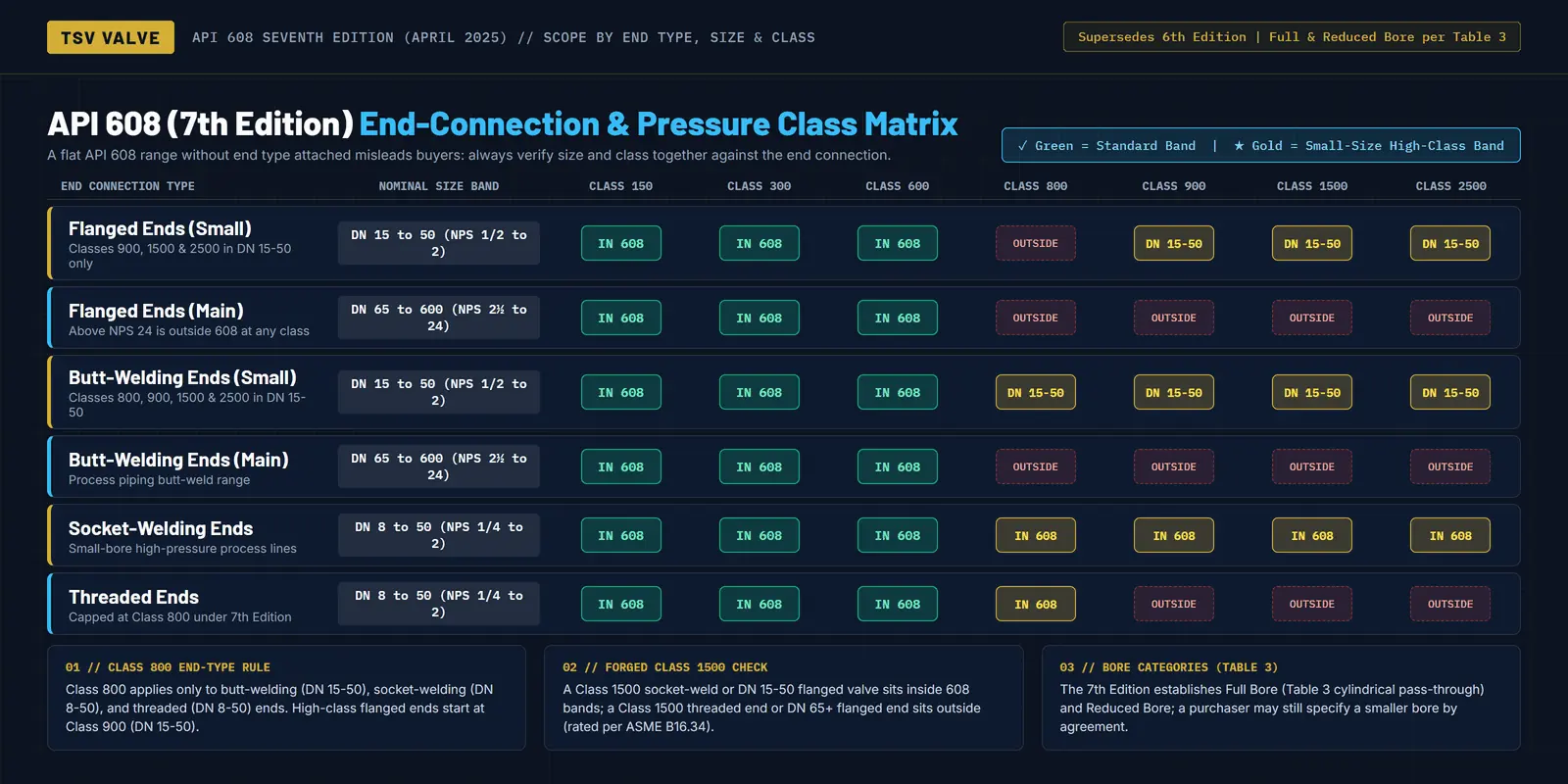
A flat 608 range, with no end type attached, will mislead a buyer at both ends of the list. It overstates what a flanged valve can cover, and it hides the small threaded and socket-weld sizes that 608 does cover.
Watch the edition on any source that still quotes NPS 20 or the sixth edition. The current edition is the seventh edition from April 2025.
The ISO counterpart named for 608 is ISO 17292. In process plant piping, buyers often pair or compare it with ASME B16.34 and BS 5351.
Test pressures for 608 are not stated in the published scope abstract, so this guide does not quote them as 608 requirements. The routine factory baseline under the seventh edition is API 598, at section 7.3, with fire testing only as required at section 7.4.
3. API 6D and API 608, side by side
The table below works as a decision tool. Read it across a row first, then down a column only when you need one standard's full picture.
| Item | API 6D | API 608 |
|---|---|---|
| Full title and edition | Specification for Valves; 25th edition, 2021-11-01, with Errata 1 to 3 and Addenda 1 to 3 | Metal Ball Valves, Flanged, Threaded, and Welding Ends; 7th edition, April 2025 |
| Governs | Pipeline and piping systems for petroleum and natural gas | Petroleum, petrochemical, and industrial applications; process facility and plant piping |
| Valve types covered | Axial, ball, check, gate, plug | Ball only |
| Ball designs | Floating and trunnion | Floating and trunnion (no seat arrangement exclusion in the scope statement; seat arrangement is a 6D DBB and DIB matter) |
| Bore | Full bore; reduced bore per Table 1 (NPS 4 to 12 one size smaller; NPS 14 to 24 one or two sizes smaller; below NPS 4 or above NPS 24 per Annex K.3) | Full bore, reduced bore; a smaller bore can still be specified by the purchaser; full bore per Table 3 cylindrical pass-through definition |
| Size range by end type | To NPS 60; by class band in Table 1 (Class 150 to 600 one merged band, anchors NPS 2 at 49.0 mm or more and NPS 4 at 100 mm or more; Class 900 minimum bores tighten from NPS 14; Class 1500 minimum bores tighten from NPS 6; Class 2500 NPS 2 at 42.0 mm or more, larger sizes no identified minimum bore) | Flanged and butt-welding: DN 15 to 600 (NPS 1/2 to 24); socket-welding and threaded: DN 8 to 50 (NPS 1/4 to 2) |
| Pressure classes by end type | 150 to 2500 (PN 20 to 420); Class 400 sits inside the Class 150 to 600 band, as an ASME B16.34 class, not a separate Table 1 band | Flanged: 150, 300, 600, plus 900, 1500, 2500 in DN 15 to 50 only; butt-welding: 150, 300, 600, plus 800, 900, 1500, 2500 in DN 15 to 50 only; socket-welding: 150, 300, 600, 800, 900, 1500, 2500; threaded: 150, 300, 600, 800 |
| End connections | Flanged, butt-welding (other end connections by agreement) | Flanged, butt-welding, socket-welding, threaded |
| Face-to-face basis | Per API 6D Clause 7 tables (flanged face-to-face and butt-welding end-to-end), Classes 150 to 2500 to NPS 60; values generally longer than ASME B16.10, especially trunnion valves above NPS 6 and long-series butt-welding ends; ASME B16.10 only supplements types and sizes not covered by the 6D tables | ASME B16.10; process floating models also reference ISO 5752 and EN 558-1 |
| Pressure-temperature basis | ASME B16.34 | ASME B16.34, Standard Class |
| Seat types | Seat material does not select the standard (see TSV section) | Seat material does not select the standard (see TSV section) |
| Double block and bleed, double isolation and bleed, and cavity relief | DBB at section 3.1.15; DIB at section 3.1.16 (DIB-1 double piston effect seats on both sides, bidirectional; DIB-2 one double and one single piston effect seat, unidirectional; a single piston effect self-relieving seat alone is not double isolation); cavity overpressure protection required, by self-relieving seat or external relief valve set at 1.1 to 1.33 times rated pressure, section 10.3 | Not a pipeline DBB package under 608; only where a supplier states it for a specific model |
| Testing | Shell at 1.5 times rated pressure or more, section 10.3, matching API 598 shell test, holds 2, 5, 15, or 30 minutes by size; seat at 1.1 times rated pressure, section 10.4, matching API 598 high-pressure seat test; low-pressure gas seat test at 0.6 MPa under 6D, while API 598 uses 80 psi (about 5.5 bar), and the page wording of 80 psi and 6 bar, plus or minus 1 bar, is factory compatibility wording, not standard text; backseat at section 10.2, gate valves with a backseat structure only (slab and expanding gate), ball valves and most check valves not applicable, at 1.1 times rated pressure at 38 degrees Celsius, 2 minute hold to NPS 4 and 5 minute hold from NPS 6, no visible leakage | Routine baseline API 598 at section 7.3, seventh edition; test pressures not stated in the published scope abstract |
| Fire testing | Type test, as specified by the purchaser (API 607, API 6FA, or ISO 10497); not a routine factory acceptance test. Exception: Addendum 2 hydrogen SLH lists fire-safe certification as a supplementary requirement | As required at section 7.4, seventh edition; routine baseline API 598 at section 7.3 |
| Marking and monogram | Monogram for licensed product in licensed scope (TSV: 6D-1832) | Monogram only under Annex A for licensed facilities; TSV process ball valves are built to ASME B16.34 and tested to API 598, with no API 608 or monogram claim |
| Documentation and inspection | TSV practice: EN 10204 3.1 and 3.2 inspection dossiers; every valve serialized and backed by complete dossiers, and every delivery includes a certified Quality Dossier | TSV practice: EN 10204 3.1 and 3.2 inspection dossiers; every valve serialized and backed by complete dossiers, and every delivery includes a certified Quality Dossier |
| ISO equivalent | ISO 14313 | ISO 17292 |
| Typical service | Transmission, gathering, terminals, pump station and manifold block service, pigging | Refinery, chemical, and gas processing plant piping; utilities; skid packages; process isolation inside a facility |
| What changes if you pick the other | Choosing 608 for pipeline duty risks losing the pipeline DBB, cavity relief, and pigging package; re-qualification may be needed if the project names 6D | Choosing 6D for plant duty may add a pipeline package the plant does not need; re-qualification may be needed if the project names 608 |
4. Which standard fits your service
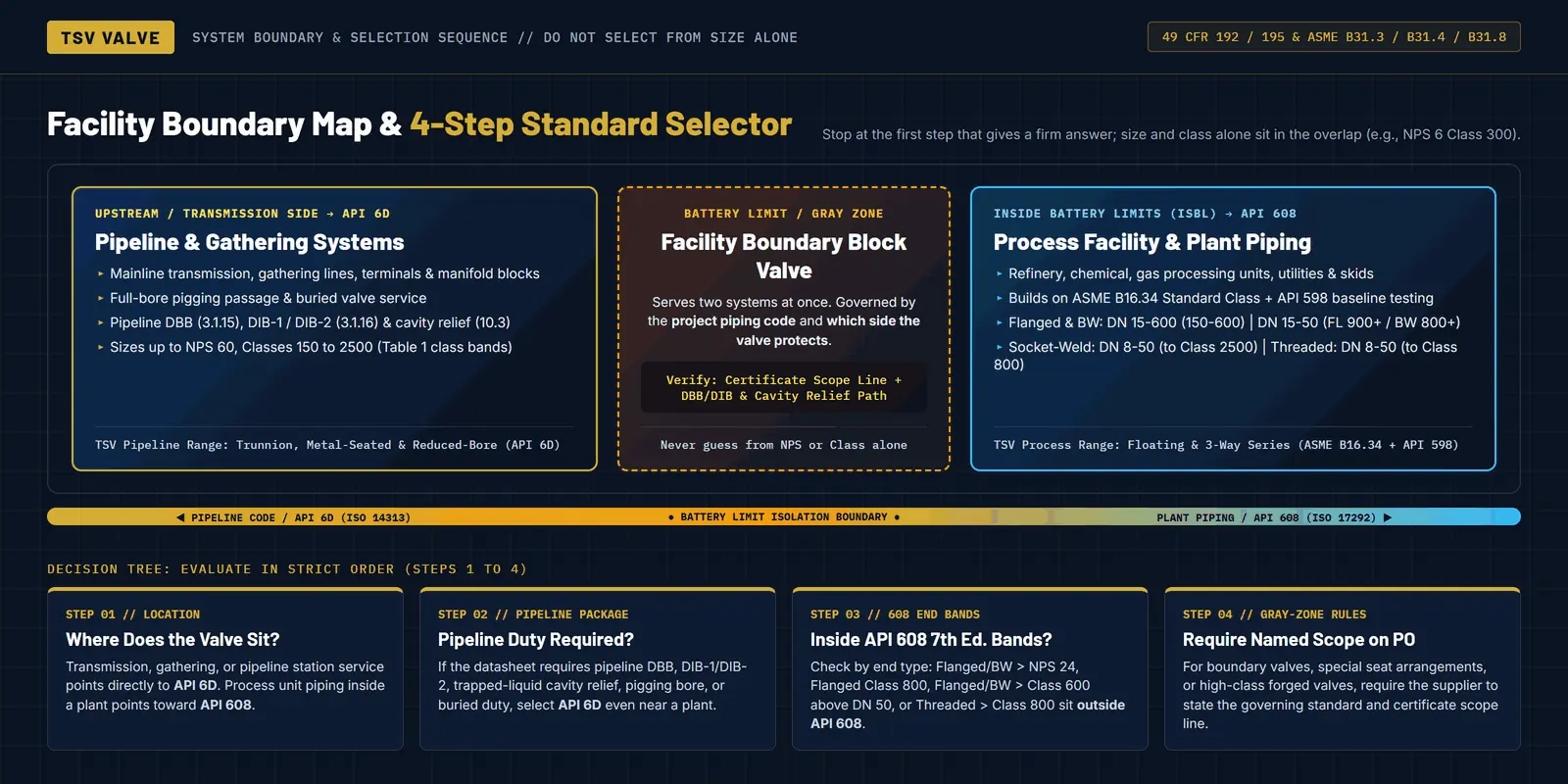
Use the tree in order. Stop at the first step that gives a firm answer, and do not jump to size, because size alone sits in the overlap.
First, ask where the valve sits. Pipeline side, including transmission and gathering lines, points to 6D.
Second, ask whether the duty needs a pipeline package. Double block and bleed or double isolation and bleed, cavity relief for trapped liquid, pigging through a full bore, or buried service points to 6D, even near a facility.
Third, check the 608 bands by end type. Flanged and butt-welding ends stay inside NPS 1/2 to 24 at Class 150 to 600 generally, with DN 15 to 50 extending from Class 900 to 2500 for flanged ends and from Class 800 to 2500 for butt-welding ends, while socket-welding ends stay inside NPS 1/4 to 2 up to Class 2500 and threaded ends cap at Class 800.
Fourth, if no step gives a firm answer, treat the case as gray zone and use the four rules below. Do not force a standard from size or class alone.
Facility boundary block valve
A block valve at a facility boundary serves two systems at once, so the project piping code and the side the valve protects decide the answer. Ask the supplier which standard the certificate scope names for that valve, and whether double block and bleed and cavity relief sit inside that scope.
Seat arrangement and cavity relief path
Single piston effect and double piston effect seat arrangements and the cavity relief path are not 608 scope tests. Ask the supplier for the exact model's seat arrangement and relief path, and check any pipeline double block and bleed or double isolation and bleed package need against the 6D definitions.
Above the 608 flanged bands
A flanged valve above Class 600 sits outside the 608 flanged bands in this guide, except at DN 15 to 50, where Classes 900, 1500, and 2500 stay inside the bands. Above NPS 24, a flanged valve sits outside the bands at any class, so ask the supplier to name the governing standard for that exact size, class, and end combination.
Port layout and seat material
Port layout and seat material do not select a standard on their own. A three-way valve still follows boundary and bands, and a metal seat still follows boundary and bands, so check the stated standard for the exact model before ordering.
What to ask the supplier
- State the standard and edition for the exact valve ordered.
- State the certificate scope line covering this valve type, size, and class.
- State the end connection and bore as ordered.
- State the seat arrangement and the cavity relief path.
- State the test regime and acceptance criteria as ordered.
- State the fire-test qualification scope, if fire-safe performance is claimed.
- State whether API 608 on the quote means a monogram product or manufacture to 608.
Pipeline service points to the trunnion-mounted series in the TSV section below. Where severe service applies, the metal-seated series is the TSV example, and where a reduced bore is ordered, the reduced-bore models that cite API 6D Table 1 are the TSV example.
Process service inside a plant points to TSV's floating series, built to ASME B16.34 with API 598 testing. Where flow must divert or mix, TSV's three-way models built to ASME B16.34 are the process example.
Gray zone cases get no single standard from this guide. They get a rule and a supplier question, so the order is placed on a named scope rather than on a size guess.
5. What TSV builds to
TSV builds pipeline ball valves to API 6D and process ball valves to ASME B16.34 with API 598 testing. The hub page for TSV's ball valves groups these series by service and design code.
The pipeline anchor is TSV's trunnion-mounted series for API 6D service. TSV lists it at NPS 2 to 48, Class 150 to 2500, with double block and bleed and double isolation and bleed seat arrangements.
For severe service, TSV's metal-seated series lists API 6D in its design list, with ASME B16.34, ISO 14313, and BS 5351. TSV lists it at NPS 1/2 to 24, Class 150 to 2500, with tungsten and chromium carbide coatings.
Reduced bore needs a model check. TSV's carbon-steel venturi model cites API 6D Table 1 for its reduced bore, at NPS 3 by 2 to 48 by 40, Class 150 to 1500, and that citation is consistent with the 25th edition Table 1 reduced-bore rules above.
The process anchor is TSV's floating series, built to ASME B16.34 with API 598 testing. TSV lists the series at NPS 1/2 to 8, Class 150 to 600, in two-piece split and three-piece bolted bodies.
For diversion duty, TSV's three-way series is built to ASME B16.34 with API 598 testing. TSV lists the series at NPS 1/2 to 12, Class 150 to 600, in L-port and T-port layouts.
When a buyer evaluates a forged floating or three-way ball valve against API 608, coverage depends on the ordered end type and size.
A flanged Class 1500 end sits inside the 608 bands only at DN 15 to 50. Above DN 50 it sits outside the bands, with its rating per ASME B16.34.
A socket-welding Class 1500 or 2500 end sits inside the seventh edition bands at DN 8 to 50. A threaded Class 1500 end sits outside the bands, since threaded ends cap at Class 800.
Shell testing runs at 1.5 times rated pressure under API 6D section 10.3, which matches the API 598 shell test. Seat testing runs at 1.1 times rated pressure under API 6D section 10.4, which matches the API 598 high-pressure seat test.
Low-pressure gas seat testing is 0.6 MPa under 6D, while API 598 uses 80 psi, about 5.5 bar. TSV's factory testing specification of 80 psi and 6 bar, plus or minus 1 bar, is a combined compatibility baseline rather than the literal text of either standard.
TSV documents this combined regime under its 100% Factory Pressure Testing SOP (API 598 and API 6D).
For 6D evidence, the license document for monogram No. 6D-1832 lists Ball Valves, Gate Valves, and Check Valves, at Class 150 to 2500, valid through July 2027. The certificate page lists CE PED Module H, notified body 2408, and no API 608 license number, as TSV builds its process ball valves to ASME B16.34 and API 598.
TSV order practice also includes EN 10204 3.1 and 3.2 inspection dossiers, with every valve serialized and backed by complete dossiers, and every delivery includes a certified Quality Dossier.
For fire evidence, this guide uses only the current ECM set. That set covers API 607 seventh edition and API 6FA fifth edition, with ball valves at 2, 4, and 8 inches at Class 1500 qualified to Class 1500 and 2500, valid to 2028, and gate valves at Class 150 and 300 valid to May 2030, with an 8 inch slab gate valve valid to March 2031.
Ball valves at Class 150 to 900 have no current-edition fire certificate here, and the DNV 2013 set is historical evidence only.
6. Frequently asked questions
Can one ball valve be both API 6D and API 608?
My valve is NPS 6, Class 300. Which standard applies?
Does floating or trunnion mounting decide the standard?
Is API 608 only for small, low-pressure valves?
What proof should I ask a supplier for before ordering?
Need API 6D or ASME B16.34 Ball Valve Scope Verification?
Send your line data sheet or valve requisition to TSV Application Engineering for a scope review and quotation; we reply within 24 hours.