
1. Root Cause of Valve Passing: Deficient Actuator Sizing vs. Mechanical Trim Damage
In process isolation and emergency shutdown (ESDV) systems, downstream valve seat leakage—commonly termed valve passing—is frequently misdiagnosed as seat erosion or particulate contamination. In reality, field failure investigations across oil and gas pipelines reveal that over 50% of seat passing incidents result from inadequate actuator thrust or torque margin. When line pressure reaches maximum design shutoff differential (ΔPmax), line fluid exerts opposing hydraulic forces against the closure member. If the actuator lacks sufficient reserve thrust, the valve plug or ball cannot overcome seat sealing reaction forces, leaving a microscopic gap that results in continuous high-velocity wire-drawing leakage.
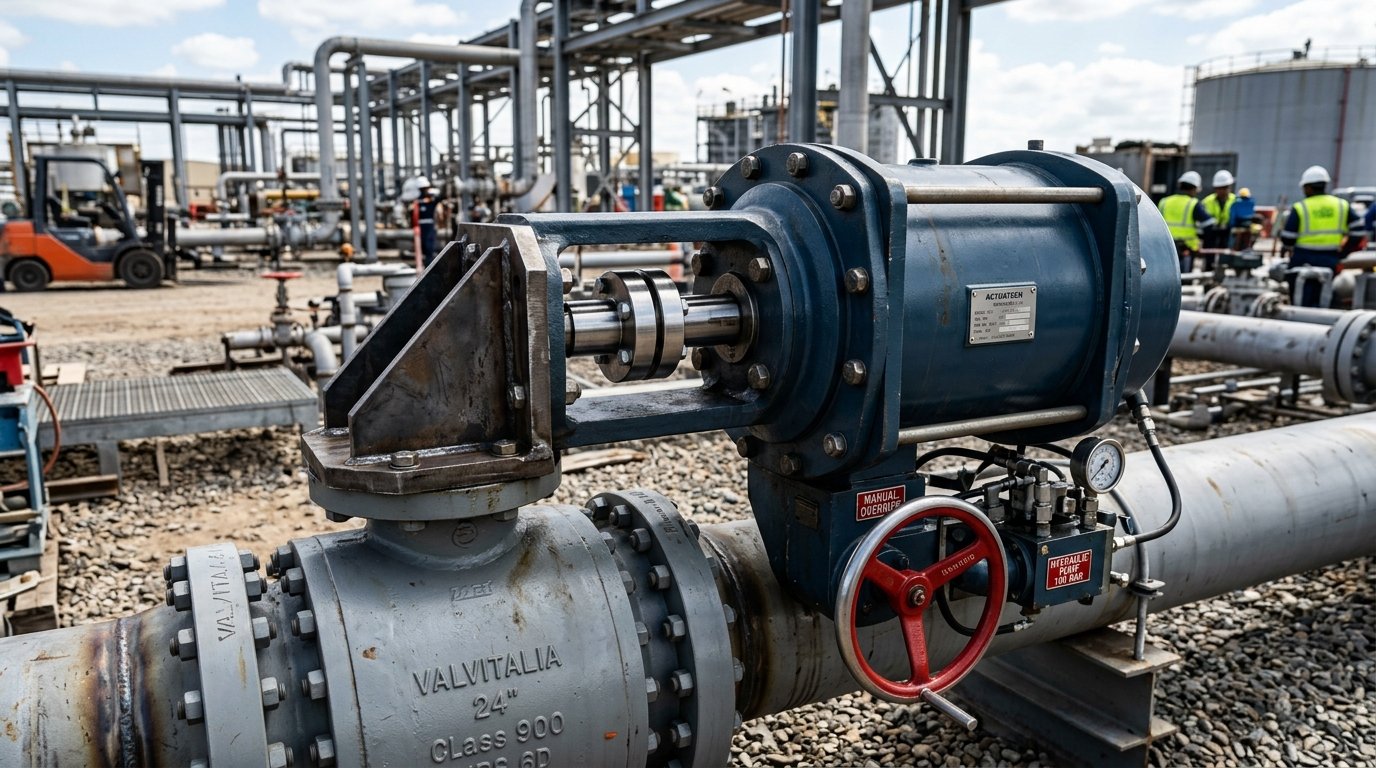
2. Four Components of Valve Operating Torque for Quarter-Turn Valves
For quarter-turn valves including API 6D Ball Valves, API 609 Triple Offset Butterfly Valves, and API 599 Plug Valves, the total required operating torque varies non-linearly across the 0° to 90° travel rotation. Sizing must account for four distinct physical torque regimes:
T_break = T_seat + T_stem_packing + T_bearing_friction
2. Running Torque (T_run): Kinetic friction torque during mid-stroke rotation (typically 25% to 35% of breakaway torque).
3. Dynamic Flow Torque (T_dyn): Fluid aerodynamic/hydrodynamic turning force exerted on an asymmetric disc (critical for high-velocity butterfly valves).
T_dyn = Ct * d³ * ΔP_dynamic
4. Reseating Torque (T_seat): Torque required to seat and wedge the closure member into bubble-tight contact at 0° closure.
3. Linear Valve Stem Thrust Equations: Unbalance Forces & FCI 70-2 Seat Loading
For globe and cage-guided control valves, the required actuator thrust Ftotal is calculated by summing hydraulic unbalance, packing friction, seat loading, and diaphragm spring compression:
Where:
• F_unbalance = A_plug * ΔP_shutoff (For unbalanced globe plugs; A_stem * ΔP for balanced cage plugs)
• F_seat = L_seat * w_seat (Seat contact load per FCI 70-2 / IEC 60534-4)
• F_packing = Stem circumference * Packing friction force per linear inch (approx. 200 to 500 N per inch)
• F_spring = Actuator spring pre-compression force at end of stroke
Seat contact loading varies drastically by required shutoff classification under FCI 70-2 / IEC 60534-4:
| FCI 70-2 / IEC 60534-4 Class | Allowable Leakage Rate | Required Unit Seat Load (w_seat) | Typical Sealing Trim Metallurgy |
|---|---|---|---|
| Class IV (Standard Industrial) | 0.01% of rated valve capacity | 40 – 60 lbf/linear inch (7 – 10 N/mm) | Hardened 410 SS / 316 Stellite 6 |
| Class V (Critical Severe Service) | 0.0005 ml/min/psid/inch of port | 180 – 300 lbf/linear inch (32 – 53 N/mm) | Precision lapped Solid Stellite 6 |
| Class VI (Bubble-Tight Soft Seat) | API 598 / FCI 70-2 Bubble Count | 80 – 120 lbf/linear inch (14 – 21 N/mm) | Virgin PTFE, PEEK, Devlon V-API |
4. Scotch Yoke vs. Rack & Pinion: Canted vs. Symmetric Torque Curves
Pneumatic scotch yoke actuators dominate heavy pipeline ball and butterfly valve actuation due to their non-linear torque curve matching the valve's mechanical requirements:
- Symmetric Scotch Yoke: Delivers balanced high torque at both ends of stroke (0° closed and 90° open), ideal for API 6D trunnion ball valves requiring equal breakaway and reseating power.
- Canted Scotch Yoke: Tilts the torque curve to deliver up to 140% breakaway torque at 0° while decreasing end-stroke torque, perfectly matched for high-performance butterfly valves where unseating torque exceeds seating torque.
- Rack & Pinion: Provides a constant flat torque profile throughout stroke. Sizing for peak breakaway torque results in an oversized, inefficient actuator package for large valves.
5. Sizing Safety Factors (SF) across Severe Process Mediums
| Process Service Condition | Minimum Recommended Safety Factor (SF) | Engineering Rationale & Considerations |
|---|---|---|
| Clean Dry Gas / Light Hydrocarbon | 1.25 (25% margin) | Clean, non-lubricating medium; low seat fouling risk |
| Demineralized Water / Superheated Steam | 1.35 (35% margin) | Thermal expansion of trim; potential mineral scale deposit |
| Crude Oil / Viscous Hydrocarbons | 1.40 – 1.50 (40–50% margin) | Waxing, asphaltene deposition, high fluid shear viscosity |
| Mining Slurry / Catalyst Fines / Dirty Sour Gas | 1.60 – 2.00 (60–100% margin) | Particulate entrapment in seat pockets; high friction build-up |
| Emergency Shutdown Valve (ESDV / HIPPS) | 1.50 minimum mandatory | SIL-3 safety reliability under degraded air supply condition |
6. Worked EPC Engineering Calculation: 10" Class 600 Trunnion Ball Valve
| Design Parameter | Specified Value | Engineering Units | Datasheet Notes |
|---|---|---|---|
| Valve Model & Size | TSV Series 2000 Trunnion Ball Valve, 10" (DN250) | inches / mm | Full Port, ASME B16.34 Class 600 |
| Maximum Design Shutoff Pressure (ΔP) | 100.0 | bar (1,450 psi) | Maximum pump shutoff deadhead pressure |
| Sealing Seat Material | Devlon V-API (Hard Thermoplastic) | — | Temperature: -29°C to 120°C |
| Base Valve Breakaway Torque (T_break) | 2,450 | N·m | Factory catalog bare-stem torque @ 100 bar |
| Process Fluid | Crude Oil with entrained sand fines | — | Recommended SF = 1.50 |
| Available Instrument Air Supply Pressure | 5.5 bar minimum (80 psig) | bar g | Regulated compressor air supply line |
Torque Sizing Calculation:
T_required = 2,450 N·m * 1.50 = 3,675 N·m
Actuator Selection: TSV Pneumatic Scotch Yoke Model SY-320S-DA
• Output Torque @ 5.5 bar air supply (0° Breakaway): 4,280 N·m
• Realized Effective Safety Factor: 4,280 / 2,450 = 1.74 (Exceeds required 1.50 minimum)
On single-acting spring return actuators, sizing must verify both Air-End Torque and Spring-End Torque independently. The spring stroke-end torque must exceed valve reseating torque by the required safety factor (SF ≥ 1.35) even when air supply has dropped to 0 bar.
7. Three Fatal Actuator Sizing Traps in Pipeline EPC Projects
- Sizing against Nominal Operating Pressure instead of Relief Pressure: Operating pressure might be 60 bar, but PSV set pressure is 85 bar. Sizing at 60 bar causes actuator stall during an overpressure emergency when isolation is most critical.
- Ignoring Low Ambient Temperature Viscosity & Seal Stiffening: In Arctic or sub-zero installations (-40°C), elastomeric O-rings and seat inserts stiffen significantly, increasing breakaway torque by 30% to 50%. Actuators must be sized using low-temperature torque factors.
- Air Supply Pressure Drop during Simultaneous Emergency Trip: When an entire valve manifold trips simultaneously, instrument air distribution headers suffer pressure drops of 1.0 to 1.5 bar. Actuator torque must always be rated at minimum degraded supply pressure (typically 4.0 or 4.5 bar).
8. Frequently Asked Engineering Questions (Technical FAQ)
Canted scotch yoke actuators provide an asymmetric torque curve that peaks sharply at the beginning of the stroke (0° unseating). Triple offset butterfly valves require immense torque to unseat from the inclined metal seat cone, but require very low running torque. A canted mechanism delivers high breakaway torque without requiring a larger cylinder size.
Industry best practices (Shell DEP, Aramco SAMSS, and IEC 61508 / 61511) mandate a minimum safety factor of 1.50 (50% torque margin) for SIL-2/SIL-3 ESDV installations, calculated using the minimum guaranteed instrument air supply pressure and maximum line shutoff differential.
Every automated TSV valve package undergoes factory torque testing under simulated full differential pressure. We record dynamic stroke torque signatures using calibrated load cells, verifying that actuator output exceeds measured valve torque by the specified safety factor across 100% of the travel arc.
Related TSV Engineering Resources:
- TSV API 6D Trunnion & Floating Ball Valves Range
- Heavy-Duty Forged Trunnion Mounted Ball Valves
- Triple Offset High-Performance Butterfly Valves
- Pressure & Torque Engineering Unit Converter
- Control Valve Sizing per IEC 60534-2-1
Need Technical Engineering Consultation or Sizing Verification?
Connect directly with TSV Application Engineering Desk for valve sizing, NACE compliance audits, and custom severe-service trim design.