
1. Regulatory Mandate & Scope of API Standard 527
Pressure Safety Valves (PSVs) and Pressure Relief Valves (PRVs) serve as the absolute last line of mechanical defense against catastrophic overpressure in pressurized process vessels, pipelines, and distillation columns. Governed by ASME Boiler and Pressure Vessel Code Section VIII, Division 1 (UG-125 through UG-136) and sized per API RP 520, a safety valve must open reliably at its set pressure and re-seat tightly once normal pressure is restored.
However, an improperly seated safety valve that exhibits chronic seat leakage ("simmering") bleeds valuable product, releases toxic emissions, and promotes rapid wire-drawing erosion across the lapped seating surfaces. Standard API 527 ("Seat Tightness of Pressure Relief Valves") establishes the globally enforced testing apparatus, test pressures, observation durations, and maximum allowable leakage rates for spring-loaded and pilot-operated safety relief valves.
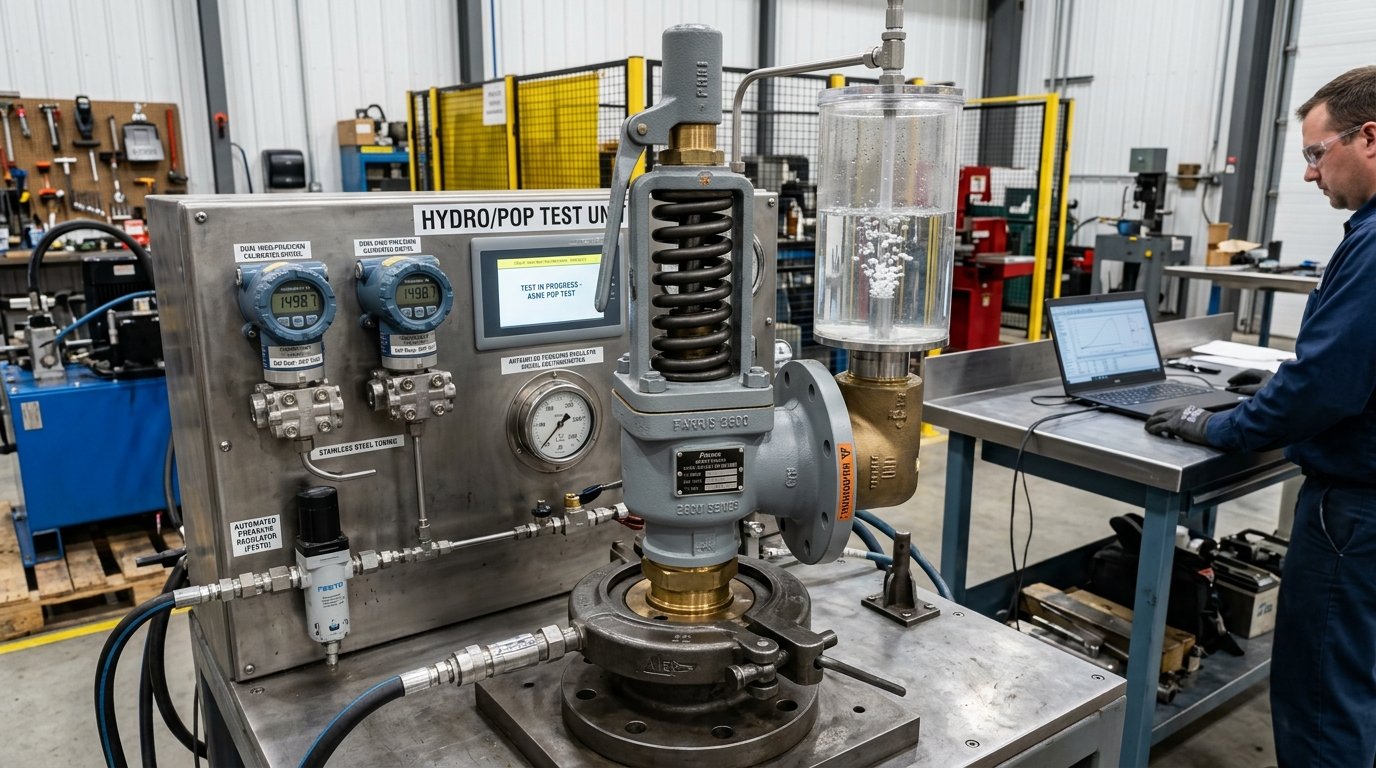
2. API 527 Standard Test Apparatus & Geometry
API Standard 527 mandates a precise, standardized test apparatus to guarantee repeatable bubble-counting geometry across all testing facilities worldwide:
• Valve Outlet Sealing: The valve discharge port must be hermetically blanked with an airtight test plate equipped with a central discharge tubing connection.
• Leakage Tube Dimensions: 5/16 inch (7.9 mm) Outside Diameter (OD) with a 0.035 inch (0.89 mm) wall thickness.
• Tube Cut & Immersion: The tube end must be cut square, smooth, and burr-free, submerged exactly 1/2 inch (12.7 mm) below the water surface.
• Water Reservoir: Clean ambient water (15°C to 30°C) held in a transparent beaker allowing clear 360° visibility of rising bubbles.
3. Test Pressure Protocol: 90% Set Pressure Rule
Seat tightness testing is conducted at a test pressure lower than the valve set pressure to prevent premature simmering while ensuring sufficient seating unbalance force:
- Set Pressure > 50 psig (345 kPa / 3.45 bar): Test pressure must be held at exactly 90% of the cold set pressure (CDTP). For example, a PSV with a set pressure of 100 psig is tested for leakage at exactly 90.0 psig.
- Set Pressure ≤ 50 psig (345 kPa / 3.45 bar): Test pressure must be held at exactly 5 psi (34.5 kPa) below the set pressure. For example, a PSV set at 30 psig is tested at 25.0 psig.
4. Allowable Leakage Bubble Count Across API 526 Orifices (D through T)
For metal-to-metal seated pressure relief valves tested with air or nitrogen, API 527 specifies maximum allowable leakage in bubbles per minute, monitored for a mandatory observation period:
| API 526 Orifice Designation | Effective Orifice Area (sq. in.) | Set Pressure Range (psig) | Minimum Observation Time | Max Allowable Leakage Rate (Bubbles / Min) |
|---|---|---|---|---|
| D, E, F | 0.110 – 0.307 | 15 to 1,000 | 1 Minute | 40 bubbles / min (approx. 2.4 scc/min) |
| G, H, J | 0.503 – 1.287 | 15 to 1,000 | 1 Minute | 20 bubbles / min (approx. 1.2 scc/min) |
| K, L, M, N, P | 1.838 – 6.380 | 15 to 1,000 | 1 Minute | 10 bubbles / min (approx. 0.6 scc/min) |
| Q, R, T | 11.05 – 26.00 | 15 to 1,000 | 1 Minute | 5 bubbles / min (approx. 0.3 scc/min) |
| All Orifices (Soft Seated) | Any Size (D through T) | All Pressures | 1 Minute | 0 bubbles / min (Zero Leakage) |
Notice the counter-intuitive principle: As orifice size increases from D to T, the allowable bubble count decreases from 40 to 5 bubbles per minute. Larger orifices feature larger seating circumferences and higher spring closing forces, requiring tighter per-unit-length seal tolerances.
5. Liquid and Steam Test Protocols per API 527
- Liquid Service Valves (Water Media): For valves designed for incompressible liquids, water is used as the test medium. The valve discharge is blanked, and liquid collecting in the outlet is monitored. For metal seats, allowable leakage is maximum 10 ml per hour per inch of nominal inlet diameter at 90% set pressure. For soft-seated valves: zero drops.
- Steam Service Valves (Saturated Steam Media): Tested on high-pressure steam boilers. Visual and audible observation of the outlet port after a 3-minute stabilization hold. There must be no audible or visible steam leakage discharging from the outlet at 90% set pressure.
6. Root Causes of In-Service PSV Simmering and Seat Chatter
Field investigations identify five recurring root causes when PSVs fail API 527 tests in the field:
- Operating Pressure Too Close to Set Pressure: Standard spring-loaded PSVs require a minimum 10% margin between normal operating pressure and set pressure. Operating at 95% of set pressure leaves insufficient net spring seating force (\(F_{net} = F_{spring} - P_{op} · A_{seat}\)), causing chronic simmering.
- Nozzle Body Flange Bending Moments: Excessive thermal expansion or unsupported discharge tailpipe loading exerts mechanical bending moments on the valve body, distorting the precision-lapped nozzle seat.
- Particulate Impingement during Initial Blowoff: Mill scale, rust, or weld spatter caught during initial plant steam blows or pipeline de-watering embeds into metal seating faces.
7. Precision Optical Lapping: Helium Monochromatic Light Verification
Achieving API 527 metal-to-metal seat tightness requires optical flatness measured in micro-inches. TSV utilizes a multi-stage lapping protocol:
| Lapping Stage | Lapping Block Material | Abrasive Compound | Surface Finish Goal |
|---|---|---|---|
| 1. Rough Cut | Cast Iron Meehanite Block | 14 Micron Diamond Compound | Eliminate scratches, pit depth > 0.05 mm |
| 2. Intermediate Grind | Cast Iron Plate | 6 Micron Diamond Compound | Establish true seat parallelism |
| 3. Finish Polish | Hardened Steel / Ceramic Plate | 1 Micron Diamond / Aluminum Oxide Paste | Mirror finish (Ra < 0.05 μm) |
Optical flatness is verified using an Optical Flat under Monochromatic Helium Light (wavelength \(\lambda = 0.5876\ \mu ext{m}\)). When placed over the lapped disc, interference dark bands indicate flatness deviations. A compliant PSV disc must exhibit straight, parallel bands within 1 to 2 light bands (0.3 to 0.6 μm total deviation) across the entire seating annulus.
Yes. While API 527 allows up to 40 bubbles per minute on small orifices, precision optical lapping to within 1 helium light band routinely achieves zero bubbles (100% bubble-tight) on brand-new metal-to-metal seats during factory testing.
CDTP is the pressure at which the valve is adjusted to pop on the ambient test bench. It includes calculated correction factors for elevated operating temperature (which weakens the spring) and superimposed backpressure, ensuring the valve pops exactly at true design set pressure in the plant.
API 527 requires holding the test pressure at 90% set pressure for a minimum stabilization period of at least 1 to 3 minutes to allow trapped air in the bonnet and nozzle cavities to stabilize before initiating the 1-minute bubble counting timer.
Related TSV Engineering Resources:
- Factory 100% Pressure Testing SOP per API 598 & ISO 5208
- API 6D & CE PED Quality Certifications
- EN 10204 3.1 & 3.2 Material Inspection Protocols
- Interactive Valve Selection Decision Matrix
- Actuator Torque Sizing & Preventing Seat Passing
Need Technical Engineering Consultation or Sizing Verification?
Connect directly with TSV Application Engineering Desk for valve sizing, NACE compliance audits, and custom severe-service trim design.