
1. The Global Regulatory Mandate: EPA LDAR, Clean Air Act, and Scope 1 Decarbonization
Industrial valve stem packing and body gasket joints account for an estimated 50% to 60% of all fugitive volatile organic compound (VOC) and greenhouse gas emissions in chemical refineries and natural gas processing plants. Under the United States Environmental Protection Agency (EPA) Leak Detection and Repair (LDAR) regulations (including 40 CFR Part 60 Subpart VVa and the EPA Consent Decrees), industrial facilities face massive financial penalties unless process valves are certified as Low-Emitting (Low-E) Valves.
Historically, valve packing was considered a consumable maintenance item expected to leak. Today, global EPC engineering specifications require rigorous third-party type testing certification under two competing international standards: ISO 15848-1 (European vacuum accumulation method) and API 641 / API 624 (North American EPA Method 21 sniffing method).
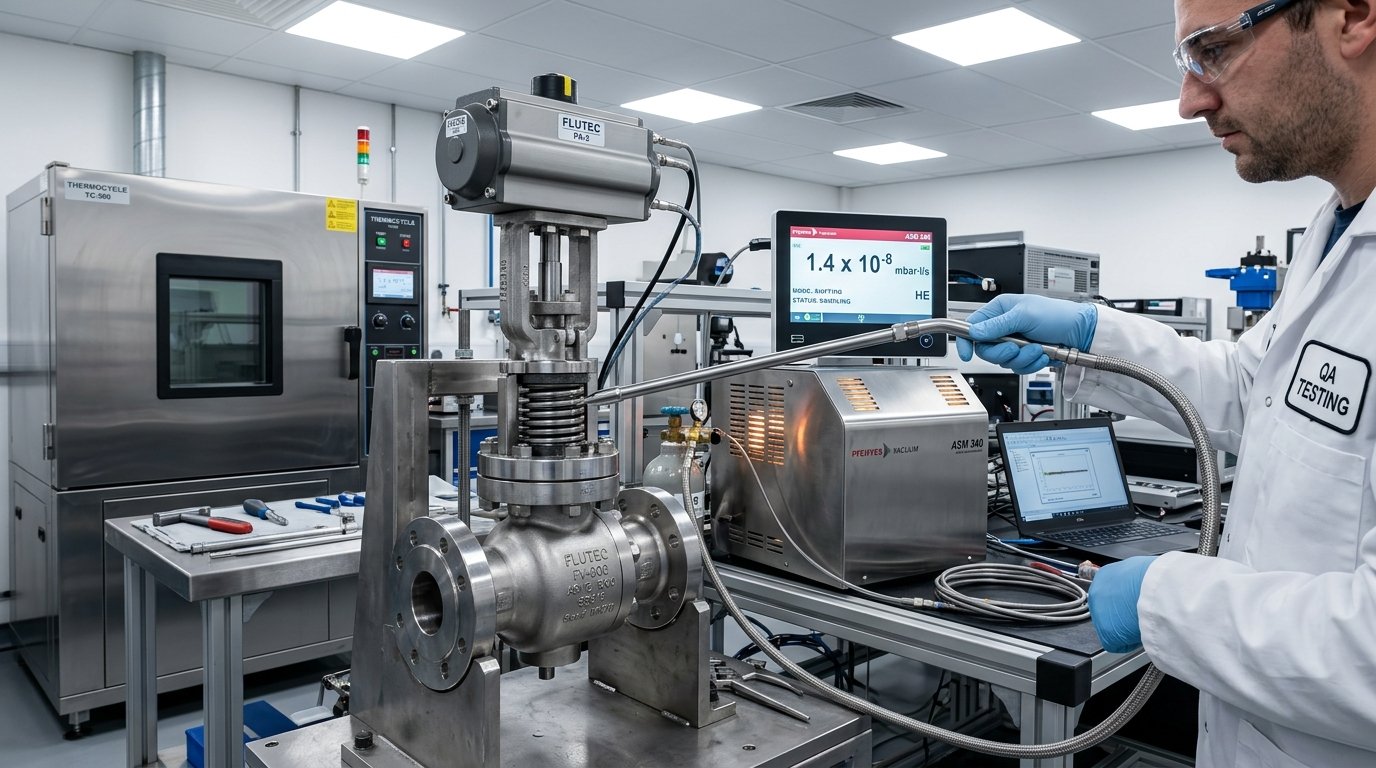
2. ISO 15848-1 Classification System: Tightness and Endurance Classes
International Standard ISO 15848-1 ("Industrial valves – Measurement, test and qualification procedures for fugitive emissions – Part 1: Classification system and qualification procedures for type testing of valves") represents the most technically rigorous qualification framework in existence. It defines performance through three parameters: Tightness Class, Endurance Class, and Temperature Rating.
| ISO 15848-1 Tightness Class | Test Media | Allowable Leakage Rate (Helium Vacuum Method) | Allowable Sniffing Concentration (EPA Method 21) |
|---|---|---|---|
| Class AH (Highest Integrity) | Helium (He) | ≤ 10⁻⁶ mg · s⁻¹ · m⁻¹ of stem circumference | < 50 ppmv (Sniffing method) |
| Class BH (Standard Severe Service) | Helium (He) | ≤ 10⁻⁴ mg · s⁻¹ · m⁻¹ of stem circumference | < 100 ppmv (Low-E benchmark) |
| Class CH (General Chemical) | Helium (He) | ≤ 10⁻² mg · s⁻¹ · m⁻¹ of stem circumference | < 500 ppmv |
| Class AM / BM / CM | Methane (CH₄) | Same mass leakage limits measured using Methane | Corresponding ppmv thresholds |
Mechanical endurance cycling classes simulate decades of plant operation:
- Isolating Valves (Quarter-Turn): Class CO1 = 205 mechanical cycles; Class CO2 = 1,500 cycles; Class CO3 = 2,500 cycles.
- Control Valves (Modulating): Class CC1 = 20,000 cycles; Class CC2 = 60,000 cycles; Class CC3 = 100,000 cycles.
- Thermal Cycling: Must include room temperature, minimum design temperature (e.g. -46°C or -196°C), and maximum design temperature (e.g. +200°C or +400°C).
3. American Standards: API 641, API 624, and API 622
The American Petroleum Institute operates a three-tiered Low-E testing ecosystem:
• Pure packing ring qualification independent of valve body.
• 1,510 mechanical cycles, 5 thermal cycles (ambient to 260°C / 500°F).
• Maximum allowable leakage: ≤ 100 ppmv Methane with ZERO gland packing adjustments permitted.
2. API Standard 624 (Rising Stem Multi-Turn Valves):
• Gate and globe valves equipped with API 622 qualified packing.
• 310 mechanical cycles and 3 thermal cycles (ambient to 260°C).
• Maximum allowable leakage: ≤ 100 ppmv Methane with ZERO gland bolt re-torquing.
3. API Standard 641 (Quarter-Turn Valves):
• Ball, butterfly, and plug valves.
• 610 mechanical cycles and 3 thermal cycles.
• Maximum allowable leakage: ≤ 100 ppmv Methane with ZERO gland adjustments.
4. Testing Methodology Comparison: Vacuum Hood vs EPA Method 21 Sniffing
| Comparison Parameter | ISO 15848-1 Vacuum Method | API 641 / EPA Method 21 Sniffing |
|---|---|---|
| Physics Principle | Total mass emission rate into sealed vacuum enclosure | Local volumetric concentration at seal boundary |
| Test Media | Helium (97% concentration) | Methane (97% purity) |
| Detection Instrument | Helium Mass Spectrometer Leak Detector (MSLD) | Flame Ionization Detector (FID) / Toxic Vapor Analyzer |
| Measurement Unit | mg · s⁻¹ · m⁻¹ (mass flux per meter of stem circumference) | ppmv (parts per million by volume) |
| Sensitivity Limit | 10⁻¹² mbar · l/s (ultra-trace atomic detection) | 1 ppmv (ambient air dilution susceptible) |
| Gland Adjustments | Recorded; affects rating classification | STRICTLY FORBIDDEN (Automatic test failure) |
5. Dynamic Stem Sealing Tribology: Graphite vs. Engineered PTFE
Achieving API 641 and ISO 15848-1 Class AH compliance requires advanced packing set design:
- Die-Formed Flexible Graphite Sets (High Temp & Fire-Safe): Formed from expanded exfoliated mineral graphite ribbons compressed to a precise density of 1.4 to 1.6 g/cm³. The stack features braided carbon yarn anti-extrusion wiper rings at the top and bottom to eliminate graphite extrusion. Contains active inorganic corrosion inhibitors to prevent galvanic pitting on 13Cr and 316 stems.
- Cup-and-Cone Virgin PTFE Sets (Chemical & Low Friction): Precision-machined V-rings that utilize fluid pressure to energize radial sealing lips against the stem and stuffing box bore, delivering zero stick-slip and ultra-low emission rates down to \(10^{-8} ext{ mg/s/m}\).
6. Belleville Spring Live-Loaded Packing Design
Flexible graphite naturally exhibits viscoelastic relaxation and creep, losing 20% to 40% of its initial installation gland stress after its first thermal cycle. To maintain permanent hermetic sealing without manual maintenance, TSV installs Live-Loaded Belleville Disc Spring Stacks:
Total Gland Preload Force (F_gland) = S_gland · A_annulus = S_gland · [ π / 4 · (D_bore² - d_stem²) ]
Belleville Disc Sizing Rules:
• Material: 17-7PH Stainless Steel or Inconel 718 (for high temp / NACE MR0175).
• Stack Arrangement: Series stacking increases stroke deflection; parallel stacking increases load capacity.
• Working Travel: Springs must be compressed to exactly 80% to 85% of full flat deflection, providing reserve elastic stroke to absorb 30% graphite relaxation while maintaining gland stress above minimum sealing threshold (S_min ≥ 25 MPa).
7. Stem Machining Tolerances and Surface Roughness Limits
A flawless packing set will leak immediately if the valve stem geometry is out of tolerance. TSV enforces strict aerospace-grade stem machining criteria:
- Surface Finish: Stem dynamic sealing journal must be diamond-burnished or cylindrical ground to a maximum roughness of \(Ra \le 0.2\ \mu ext{m}\) (8 micro-inches).
- Stuffing Box Bore Finish: Maximum roughness \(Ra \le 1.6\ \mu ext{m}\) (63 micro-inches) to anchor the outer packing diameter.
- Cylindricity and Straightness: Total runout must not exceed 0.025 mm (0.001 inch) per 300 mm of stem length to eliminate radial runout leakage during stroke.
Yes, plant maintenance can retighten packing gland bolts in service. However, during the initial statutory API 624 or API 641 type test, zero gland packing adjustments are permitted throughout all 610 mechanical cycles and 3 thermal cycles. Any re-torquing during the test constitutes an immediate test failure.
Ppmv is a concentration metric that varies with ambient air flow, hood volume, and detector distance. By measuring actual mass leakage (mg/s) and normalizing by the stem circumference (m), ISO 15848-1 provides a true, physics-based mass emission rate independent of valve size or testing enclosure geometry.
To satisfy EPA LDAR Consent Decrees, a manufacturer must provide a third-party witnessed test certificate proving the valve design successfully passed API 624 (for multi-turn) or API 641 (for quarter-turn) with methane leakage strictly under 100 ppmv, backed by API 622 qualified packing.
Related TSV Engineering Resources:
- TSV API 6D Low-E Trunnion Ball Valves
- TSV Severe Service Low-Emission Control Valves
- API 6D & CE PED Quality Certifications
- Factory 100% Pressure Testing SOP per API 598 & ISO 5208
- NACE MR0175 / ISO 15156 Sour Service Valve Metallurgy
Need Technical Engineering Consultation or Sizing Verification?
Connect directly with TSV Application Engineering Desk for valve sizing, NACE compliance audits, and custom severe-service trim design.